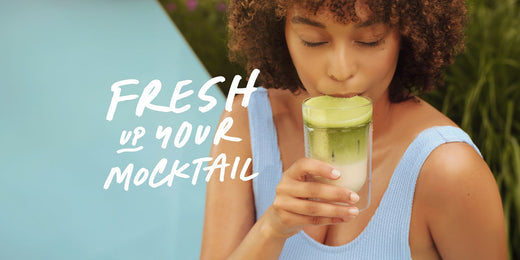
Sober curious means questioning your own drinking habits on purpose — no pressure, no diagnosis, no all-or-nothing rule. You don't need a problem with alcohol to try it. You just ask yourself: do I actually want this drink, or am I on autopilot?
That's what this guide is about: a quick look at what sober curious means and where it comes from, then a lot more on how to try it this week. At home, at your next dinner, at your next party. No finger-wagging, and no need to justify yourself to anyone.
Sober curious – what does it actually mean?
Sober curious literally means being curious about sobriety. It's a mindset, not a rule: you notice when, why and how much you drink, then make a conscious choice instead of reaching for the glass on reflex.
That's what sets it apart from classic abstinence. Abstinence means giving up alcohol completely, often for good, for health, religious or personal reasons. Sober curious is more open: some people skip alcohol for one evening, some for a month, some for good, and some simply cut back. There's no wrong way to do it.

An example makes it concrete. Ask yourself at an after-work beer, "Do I want this, or is it just Friday?" Say yes one time and no the next, and you're already sober curious. No diagnosis needed, no rock-bottom moment. Just a willingness to pause for a second.
Where does the sober curious movement come from?
The term was coined by author Ruby Warrington, whose book "Sober Curious" came out in the US in 2018. Before that, she founded "Club Soda NYC" in New York: evenings for professionals who wanted to rethink their relationship with alcohol without having to label themselves an alcoholic.
The difference from older sobriety movements: sober curious isn't built on asceticism or on having survived addiction, but on curiosity. The trend travelled from the US to Europe and has now arrived in Germany too. You can see it in the fact that almost every restaurant now offers alcohol-free wine, and sober curious parties in big cities are no longer a niche thing.
A recent survey shows how seriously the trend is taken: according to a YouGov survey from January 2025, 55 percent of people in Germany can imagine going without alcohol for a month. Sober curious is no longer a niche trend for a small scene. It has gone mainstream.
How to try sober curious yourself
Sober curious isn't something you "complete" in a weekend. But you can start in four doable steps, with no big announcement.
Step 1: Find your own motivation — no reason required
Before you change anything, take an honest minute: why are you interested right now? Maybe it's better sleep, fewer hangovers, a clearer head the next morning. Or simply curiosity about how an evening without alcohol feels. There doesn't have to be a "problem" behind it. Curiosity is reason enough.

Step 2: Start small instead of making big rules
Forget the resolution "never drinking again". Pick a small, concrete frame instead:
- one alcohol-free weekday, fixed in your calendar
- one week without, as a test
- one single event where you consciously say no
Small, repeatable decisions last longer than big resolutions, and you find out faster what feels good to you.
The reason is simple: a resolution that lasts "forever" quickly feels like deprivation. A test that ends after a week feels like an experiment. And an experiment is much easier to extend than a ban is to break.
Step 3: A glass in your hand — that's already enough
The easiest trick for staying relaxed at evening events: hold something. A glass with ice, tonic and a slice of lemon looks like any other drink at first glance. Nobody asks, nobody comments. Social pressure rarely comes from the no. It comes from the empty hand.
Step 4: Your comeback to "Not drinking?"
Have one line ready so you don't have to invent it on the spot. For example: "Not tonight, I'm trying something new" or "I have an early start tomorrow". Short, friendly, no justification. Most people don't ask a second time after that one answer.

Going out in the evening without explaining yourself
This is where sober curious stands or falls in real life: not at your own kitchen table, but at the birthday party, the work dinner, the pub table with friends.
The good news: the moment is usually far less dramatic than it feels in your head. Say "No thanks, I'm having something else tonight" with confidence, move straight on to the next topic, and you'll rarely meet real resistance. Judgment often exists only in your imagination, and it tends to disappear once you stay relaxed yourself.
A few things help on top of that:
- Bring your own drink if you're not sure there will be alternatives.
- Don't be the first to explain it. A quick "I'm going alcohol-free tonight" is enough. No speech needed.
- Team up if you can. Often someone else at the table is quietly drinking less too, you just don't notice at first.
If you feel unsure, plan your exit in advance: a time limit in your head ("I'll stay until 11") takes off the pressure to keep up until the very end. Sober curious doesn't mean skipping every party. It means going with a conscious decision, and with a drink in your hand that looks as good as any cocktail.

Mocktails & tea drinks: your alcohol-free home bar
This is where mocktails come in. They're no longer a consolation prize but a category of their own, with their own standards. If you're going alcohol-free, you don't have to end up with water and lemon.
Tea works especially well for this: it brings colour, aroma and complexity that a simple soft drink doesn't, and it can be served cold, mixed and topped with soda just like a cocktail. In our mocktail recipes you'll find 12 ready-to-mix ideas, from the crisp, slightly bitter matcha tonic to fruity, sparkling creations. If you want to experiment yourself, our recipe section has everything you need for tea mixology at home, no bartending experience required.
For a relaxed evening at home, a simple setup is often enough: a naturally caffeine-free tea as the base, brewed and cooled, plus soda or tonic and ice. Here's how it works in three steps:
- Brew the tea with hot water, let it steep and cool down completely (or leave it in the fridge overnight).
- Fill a glass with plenty of ice and pour in the cooled tea until the glass is half full.
- Top up with tonic or soda and garnish with a slice of citrus or a sprig of herbs. Done.
A fruity, spicy rooibos with a citrus note brings exactly the freshness you'd get from a gin and tonic, just without the alcohol. For a calmer end to the evening, a mild herbal blend served hot works just as well, as a conscious counterpart to the after-work glass of wine. Our organic herbal tea collection is naturally caffeine-free, which makes it a good base for evening rituals like this.
If you're looking specifically for alcohol-free alternatives, you'll also find them in our Alcohol-Free Alternatives collection, for anyone curious about more modern drinks without alcohol who doesn't want to give up on enjoyment. And for the moment after, when the evening can slow down, take a look at our Calm & Reset collection.